Google Tag Manager

Search Library Soup

Loading

Friday, June 15, 2012

INTERNATIONAL CONFERENCE ON ACADEMIC LIBRARIES


FEBRUARY 12-15, 2013
Guru Gobind Singh Indraprastha University
Sector 16 C — Dwarka
New  Delhi 11 00 75, INDIA


Conference Theme:
ACADEMIC LIBRARY SERVICES THROUGH CLOUD COMPUTING

CLOUD COMPUTING
Clouds are defined as a large pool of easily usable virtualized computing resources (such as hardware, development platforms and/or services) on the Internet. Cloud computing is about a new model for delivering, sharing, and sourcing computing resources on global network, offering opportunities for centralization of information and computing resources in data centers. Cloud computing is visualized as the next stage of evolution of the Internet. Cloud computing comes in several different models - software, platform, and infrastructure as a service. Libraries can benefit from cloud computing by opting to sign up IT resources hosted on the Internet instead of owning them locally. Cloud computing solutions could be beneficial to libraries in three basic areas: technology, data and user community. Cloud OPAC and cloud ILS illustrate innovative uses of cloud computing.  OCLC has joined vendors offering cloud-based ILS tools that complement their existing cataloging tools (e.g. WorldCat and FirstSearch).

Conference Background:
ICAL-2009, which was held in Delhi University, India, identified Globalizing Academic Libraries as the Academic Library Vision - 2020 for repositioning libraries into next generation libraries. In its outcome, ICAL 2009 outlined a roadmap for change management and identified strategic areas for the purpose. These include (i) moving libraries to the Web to encourage library collaboration (ii) sourcing ICT applications and services on the Internet as a service if it is not feasible for libraries to own them (iii) policies, programmes, and systems  for ICT integration at library level and consortium level (iv) new and qualitative dimensions to academic library services (v) strategic and academic roles for libraries and librarians that add value to academic enterprise (vi) new digital resources that libraries should undertake to emerge as  knowledge centres (vii) standards for qualitative performance in library services (viii) international collaboration on all library fronts (ix) talent development in priority areas of interest to libraries and (x) change management strategies. The ICAL-2013 plans to explore cloud computing technology for this purpose.


Scope of the Conference:
Inspired by the latest advances in virtualized computing resources on the global network, the2nd International Conference on Academic Libraries(ICAL-2013) seeks to explore how cloud computing could be applied for library applications, in particular for moving libraries to the Web. In addition, it seeks to understand how Web based computing resources could be harnessed to achieve the ICAL 2009 vision of 'globalizing libraries'. Being a new and emerging area, Cloud computing has generated much interest in library applications.Predictions are that within five years, all library collections, systems, and services will be driven into the cloud. Individual and standalone library systems such as Library Management Systems, Electronic Resource Management Systems may eventually be replaced by Cloud LMS, Cloud OPAC, Cloud ERMS, etc., thereby opening up fresh opportunities to libraries for ushering more meaningful opportunities for collaboration on the Cloud. The Conference will focus on innovative uses of cloud computing for strengthening library services with the ultimate objective of repositioning academic libraries into next generation libraries. The Conference will also focus on harnessing cloud computing for formulating action plan to give effect to ICAL-2009 roadmap on globalizing academic libraries. The conference aims to provide a forum for presentation of issues on virtualized computing resources on the global network through original presentations, and extending opportunities to exchange and present knowledge and out of box ideas at the highest technical level.

Conference Objectives:

  • Cloud computing solutions for managing library functionalities and services over the Internet
  • Cloud computing approach for globalizing academic libraries 
  • Systems and programs that facilitate implementation of cloud computing solutions 
  • Systems and programs that facilitate adding new dimensions to academic library services
  • Systems and programs that facilitate collaborative approach to library education, training and research
  • Policy changes and strategies for program implementation

FIRST CALL FOR PAPERS
Original research papers and case studies are invited on following sub themes:

SUB-THEME 1 -Status of Academic Libraries in the Higher Education System
*      in India, Asia, Asia-Pacific and the West
*      in central and state universities in India
*      parameters for comparative evaluation of libraries
*      factors responsible for current status of libraries
*      Note: Participants from Asia and the Asia-Pacific Academic Librarians may like to present studies on  the status of academic libraries in their region
SUB-THEME 2 - Cloud Computing Models & Services 
*      cloud computing technology and science
*      types of cloud services
*      cloud computing architecture
*      private and public cloud
*      security and risk issues
*      benefits , qualities, and limitations of cloud computing vis-à-vis  other computing technologies, solutions
*      open source and cloud computing
*      cloud computing initiatives
SUB-THEME 3 - Cloud Computing Solutions for Globalizing Academic Libraries
*      case studies on library applications of cloud computing
*      collaborative models of library services 
*      new dimensions to academic library services on the cloud
*      services that offer academic roles to the academic libraries and professionals
*      systems and technologies required for cloud computing applications
SUB-THEME 4 - Change Management Issues and Strategies
*      roles of corporate, academic, and public sectors in cloud computing development and implementation for academic libraries 
*      issues, policies, programmmes, and strategies for change management through cloud computing 
*      institutional framework required for change management
*      barriers to change management and to library
SUB-THEME 5 - Library Services on the Cloud - Standards and Best practices
*      data interoperability, data storage, data security, data   validation, data preservation, data migration and backward data integration
*       content development
*      developing common library collections and resources, production and delivery of library services
*      quality upkeep and maintenance of library facilities
*      procurement, up-gradation, replacement and maintenance ICT infrastructure at consortia and client level
*      staffing global academic libraries at consortia level (the national level) and at client level (the university level);
*      norms for budget allocation at consortia and client level
SUB-THEME 6  - National Library Policy for Globalizing Academic Libraries
*      library participation in the global library  environment,
*      collection building and services at national and university level;
*      collaborative models for building e-resources for globalized library services;
*      policy for creation, development and adoption of open source software at consortia and client level;
*      collaborative programs for education, training, and research.
SUB-THEME 7 : — Talent Development & Library Research Programmes
*      skill development issues  in library and information science, ICT areas for library applications, and management
*      collaboration in library education, training and research at state, national, and global  level
*      institutional framework planning for education, training and skill development;
*      incentives for training and skill development;
*      revamp LIS education, training and research facilities


TIMELINE FOR PAPER SUBMISSIONS
Paper submission : April 5 – Sept 5, 2012                                       
Final  version submission  July 10 – Nov 5, 2012
Paper acceptance notification : June 5 – Oct 5, 2012                          
Slide Presentation copy by  - Nov  25, 2012

ONLINE PAPER SUBMISSION: -  Papers should be submitted electronically using EasyChair (https://www.easychair.org/account/signin.cgi?conf=ical2013) submission system. Submission through EasyChair requires that an account in the system be created by a prospective author first. In order to create a new account, select the "I have no EasyChair account" option and follow the instructions given.
PAPER SUBMISSION BY EMAIL: - Authors may submit papers by e-mail toical2013.os@gmail.com,  Ical2013.sm@gmail.com  in case they are unable to use EasyChair Conference system.

GUIDELINES FOR SUBMISSION OF PAPERS
1.      Structure of the paperTitle of the paper - title should be concise and expressive of the content; a sub-title may be added if required - Name/s of author/s, Institution address, city and country - Abstract not exceeding 250 words. - Keywords up to 10 - Body of the paper - References  (APA Style);
2.      Length of paper: 3 – 10 pages (A4 size), single space, 12 point font size, Times New Roman, Word or RTF file format;
3.      Tables and Figures may be incorporated into the text of paper as close to where they are first referred;
4.      Papers may be written and presented in English. The Conference offers no provision for interpreters;
5.      Paper in language other than English language should be accompanied with  English version;
6.      Avoid using unexplained acronyms, sets of initials, and phrases not understandable to international audience;
7.      Keep to timeline to see your paper in Conference website, and inclusion in the Conference papers CD;
8.      ICAL shall have the first publication rights to papers presented at the conference;
9.      Please attach a short CV on a separate page .

  WHO SHOULD PARTICIPATE
*      Academic fraternity in teaching, learning and research;
*       Library and Information Science professionals;
*       Students and Research Scholars;
*       Information Technology professionals;
*       Management Professionals,  Knowledge workers;
*       Policy makers,  Archivists;
*       Content and knowledge managers;
*       IT  & Information Service providers;
*      Electronic publishing and  virtual communities
  
For all queries and further details, please contact:

ICAL 2013 Conference Secretariat
Subhash Deshmukh, Organizing Secretary,
University Librarian, Central Library,
GGS Indraprastha University,
Sector 16C - Dwarka New Delhi 110 075 (INDIA)
Phone: +91 11 25302218 Mobile:+91 9873680484 Fax:+91 11 25302111


Library Assistant Vacancy at Indian Institute of Tourism and Travel Management

Post:- Library Assistant
No. of Post:- 02 (1 UR, 1 OBC)
Adv. No:-  09/2012
Place of Posting:- Delhi and Nellore
Scale:- 9300-34800 (PB-2, 4200 GP)
Last Date:- 27 July 2012
Website:- www.iittm.org


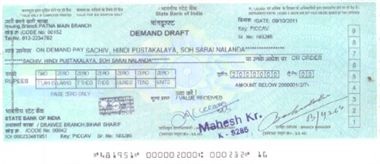
वैधता तिथि के बाद पहुंचा 20 लाख का ड्राफ्ट


वैधता तिथि के बाद पहुंचा 20 लाख का ड्राफ्ट
बिहारशरीफ, निज संवाददाता : बाबुओं का चक्कर ऐसा चला कि पुस्तकालय विकास के लिए सरकार द्वारा आवंटित बीस लाख रुपये का ड्राफ्ट वैधता तिथि समाप्त होने के बाद पहुंचा। हिन्दी पुस्तकालय सोहसराय के सुदृढ़ीकरण के लिए 9 अक्टूबर 2011 को भारतीय स्टेट बैंक का डिमांड ड्राफ्ट जारी किया गया था। यह ड्राफ्ट पुस्तकालय के सचिव को 8 जून को प्राप्त हुआ। जबकि यह 6 महीने के लिए ही वैध था। अब पुस्तकालय के समक्ष नई परेशानी खड़ी हो गयी है। सचिव योगेन्द्र प्रसाद गुप्त ने ड्राफ्ट के नवीकरण के लिए पुस्तकालय अधीक्षक पटना को पत्र लिखा है।
सरकार के एक निर्णय के अनुसार राज्य के सात पुस्तकालयों को विशिष्ट पुस्तकालय का दर्जा दिया गया है जिसमें सोहसराय के श्री हिन्दी पुस्तकालय भी शामिल है। वित्तीय वर्ष 2011-12 में राज्य योजना के तहत इन चिह्नित पुस्तकालयों को सुदृढ़ीकरण के लिए प्रत्येक को बीस लाख रुपये आवंटित किये गये। हिन्दी पुस्तकालय सोहसराय को बैंक ड्राफ्ट संख्या 481951 के माध्यम से बीस लाख रुपये दिये गये। लेकिन ड्राफ्ट 8 महीने बाद पहुंचा जो फिलहाल कागज का एक टुकड़ा मात्र के बराबर है।
कौन-कौन पुस्तकालय विशिष्ट
राज्य पुस्तकालय पूर्णिया, राजकीय उर्दू पुस्तकालय पटना, श्रीमती राधिका सिन्हा इंस्टीच्यूट एवं सच्चिदानंद सिन्हा लाइब्रेरी पटना, जिला केन्द्रीय पुस्तकालय मुंगेर, हिन्दी पुस्तकालय सोहसराय, शारदा सदन पुस्तकालय लालगंज वैशाली है।

Thursday, June 14, 2012

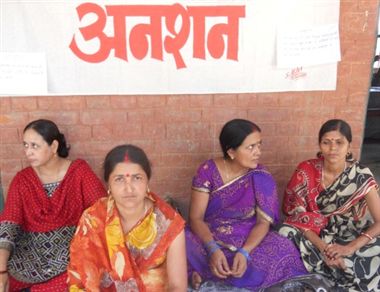
राशि विसंगति को ले अनशन पर बैठी पुस्तकालय सहायक


राशि विसंगति को ले अनशन पर बैठी पुस्तकालय सहायक
भभुआ, कैमूर,
मंगलवार को शहीद संजय महाविद्यालय इंटर की पुस्तकालय सहायक शशिलता वेतन विसंगति को दूर करने को प्राचार्य कक्ष के सामने अनशन पर बैठी।
अनशन पर बैठी शशिलता ने बताया कि प्रधानाचार्य अपने चहेते शिक्षक एवं शिक्षकेत्तर कर्मचारियों को अनुदान राशि में से अधिकतम राशि दिलवायी है। मुझे कम राशि निर्धारित करायी गयी है। इस विसंगति को दूर करने के लिए मैने महाविद्यालय के सचिव सह अनुमंडल पदाधिकारी तथा अध्यक्ष सह जिलाधिकारी कैमूर से बार-बार आग्रह किया कि मेरे वेतन की विसंगति व अनुदान की राशि वितरण मे हुई विसंगति को दूर किया जाये लेकिन इस पर कोई ध्यान नहीं दिया गया। लाचार होकर मैने उच्च न्यायालय में याचिका दायर किया है। उन्होंने कहा कि वेतन वृद्धि का मामला उच्च न्यायालय में लंबित है लेकिन शासी निकाय द्वारा मेरी गत वर्ष की भांति मिलने वाली अनुदान राशि भी इस वर्ष रोक दी है। तथा सभी कर्मचारियों के मासिक वेतन वृद्धि दो-दो बार की गयी है। उन्होंने कहा पूर्व की भांति मिलने वाली अनुदान की राशि पाने के लिए सभी कर्मचारियों की तरह अपनी वेतन वृद्धि के लिए तथा विसंगति दूर करने के लिए अनशन शुरू किया है यह कर्मिक अनशन 12-12 घंटे का होगा जो मांगे पूरी होने तक जारी रहेगा।
अनशन में शालनी सिंह, घनश्याम सिंह, राकेश कुमार सिंह, शशि कुमार , दिनेश कुमार गुप्ता, भानू कुमार गुप्ता शामिल थे।

UGC-NET Objective Question, Practice Set A


PRACTICE SET-A

1. Number of devices that are related to recall and precision has been studied by
(A) Gilchrist
(B) Vickery
(C) Lancaster
(D) Ranganathan

2. User studies in Social Sciences was carried out by
(A) Kuhn
(B) Brittain
(C) Line
(D) Allen

3. An entry that is made for the subject of a chapter in a book is referred to as
(A) Cross Reference Entry
(B) Cross Reference Index Entry
(C) Class Index Entry
(D) Book Index Entry

4. The concept of UBC was introduced by
(A) UNESCO
(B) LC
(C) FID
(D) IFLA

5. In Sears, List of Subject Headings preferred headings are indicated by
(A) Marking them as preferred headings
(B) Printing them in bold type
(C) Underlining them
(D) Italicising them

6. Identify the association that has changed its original name:
(A) ILA
(B) SLA
(C) LA
(D) ALA

7. Conference proceedings are considered as documents.
(A) Conventional
(B) Primary
(C) Secondary
(D) Tertiary

8. Rules for Dictionary Catalogue were devised by:
(A) A. Pannizzi
(B) C. C. Jewet
(C) S. Lubetzky
(D) C. A. Cutter

9. RSS feed is a tool of:
(A) Graphic design
(B) Web 1.0
(C) Web 2.0
(D) Architecture

10. An appropriate source to find out descriptive information is
(A) Bibliography
(B) Directory
(C) Encyclopedia
(D) Dictionary

11. Glossary is a:
(A) List of technical words with definitions
(B) List of words in a language
(C) List of thematically arranged words
(D) Alphabetical index to passages of work

12. One of the following search engines is exclusively meant for scientific information:
(A) Google
(B) Yahoo
(C) SCIRUS
(D) Altavista

13. Technological Gatekeeper is :
(A) A formal method of giving current awareness service
(B) A method of technology assessment and evaluation
(C) A process of transfer of technology
(D) An informal mechanism of keeping user informed of relevant development

14. Who among the following honoured with ‘Nobel Prize’ for his substantial contribution in Documentation?
(A) S. C. Bradford
(B) Loosjes
(C) Eric De Grolier
(D) Henri La Fontaine

15. The Farmington plan is associated with:
(A) Library Legislation
(B) Library Cataloguing
(C) Library Cooperation
(D) Library Indexing Service

16. UNESCO assisted Model Public Library in India is located at:
(A) Kolkata
(B) Delhi
(C) Mumbai
(D) Chennai

17. Mark the ‘odd one out’:
(A) Cow-Calf principle
(B) Principle of osmosis
(C) Wall picture principle
(D) Whole organ principle

18. Information is …
(A) Raw data
(B) Raw knowledge
(C) Input data
(D) Organized data

19. ‘Fair use’ is a term most relevant to:
(A) Intellectual Property Rights
(B) Books borrowed for home reading
(C) Copy right
(D) Use of reference books

20. WIPO stands for:
(A) World Information and Patents Organisation
(B) World Intellectual Property Organisation
(C) World International Property Organisation
(D) World Information Protection Organisation

21. Handling of Information in the sense of production is called:
(A) Information Marketing
(B) Information Industry
(C) Information Production
(D) Information Revolution

22. GUI stands for :
(A) Graphic User Interface
(B) Graphic User Interaction
(C) Graphic Utility Interface
(D) Great Union of India

23. Shelf list facilitates
(A) Classification
(B) Weeding out
(C) Stock verification
(D) Documentation

24. The office of Patent Information System in India is at
(A) Mumbai
(B) New Delhi
(C) Kolkata
(D) Nagpur

25. Questionnaire is a:
(A) Research method
(B) Measurement technique
(C) Tool for data collection
(D) Data analysis technique

26. A periodical evaluation of an employee is done through
(A) Job rotation
(B) Performance appraisal
(C) Refresher course
(D) Work guide

27. CCF stands for
(A) Current Classification Format
(B) Current Communication Format
(C) Common Communication Format
(D) Common Classification Format

28. “Controlled Group” is a term used in
(A) Survey research
(B) Historical research
(C) Experimental research
(D) Descriptive research

29. ‘Noise’ in Information Retrieval is due to
(A) Precision
(B) Recall
(C) Relevant information
(D) Redundant information

30. BERN CONVENTION (1886) is concerned with:
(A) Translations
(B) Copyright
(C) Patent
(D) Standards

31. List-I                                                            List-II
   (Forms of Communication)                                (Medium)
(A) Communication Barrier                                1. Radio
(B) Communication Medium                               2. Shannon and Weaver
(C) Communication Model                                 3. Formal
(D) Communication Channel                               4. Noise
Code :
              (a)         (b)            (c)           (d)
(A)          1           2              3             4
(B)           4          1              2             3
(C)          2           3              4             1
(D)          3           2              1             4

32. Informal communication among knowledgeable person is known as:
(A) Invisible College
(B) Information Gatekeeper
(C) Communication Gatekeeper
(D) Knowledge Management

33. Match the following :
         List-I                                                            List-II
   (  Terms )                                                            (Forms of Communication)
(A) Invisible College                                             1. Physical carrier
(B) Noise                                                             2. Formal channel
(C) Medium                                                         3. Barreir
(D) Document                                                      4. Informal channel
Code :
              (a)         (b)            (c)           (d)
(A)           1          2              3             4
(B)           2          1              3             4
(C)          4           3              2             1
(D)          4           3              1             2

34. Which one of the following is not associated with the communication system?
 (A) Receiver                              
(B) Channel                            
(C) Sender                              
(D) Entropy                        

35. Which is correct logical sequence of the following?
(A)  Information, Knowledge, Data, Wisdom                            
(B)  Knowledge, Wisdom, Information, Data                          
(C)  Wisdom, Information, Data, Knowledge                              
(D)  Data, Infomation, Knowledge, Wisdom                      

36. The invisible web refers to-
(A)  the internet, since we cannot see it                            
(B)  that part of the internet, which is hidden from the search engines                          
(C)  the telecommunication signals which are not seen                              
(D)  the failure in accessing the web pages                        

37. Who was the chairman of National Library Committee of India.
(A)   B.S. Jha                        
(B)  K.P. Sinha                        
(C)  S. Mudaliar                              
(D)  C.D. Deshmukh                      

38. Which organisation applied Library and Information Policy in India at national level.
(A)   NISSAT                        
(B)  INSDOC                      
(C) UNESCO                            
(D)  RRRLF              

39. Where is the head quarter of Patent Information System in India.
(A)   Pune                  
(B)   Mumbai                  
(C)  Nagpur                        
(D)  Delhi                    

40. The act enacted in India in 1856 on Intellectual Property Right was based on .
(A)  American Patent Law 1810                        
(B)  British Patent Law 1852          
(C)  The Patent Bill                          
(D)  The Design Act of 1911                    

41. Whether intellectual property can be sold.
(A)  No
(B)  Sale is possible
(C)  Yes
(D)  None of these

42. The term communication came from which language?
(A)  Greek
(B)  Latin
(C)  German
(D)  French

43. Who is the propounder of the term information transfer?
(A)  Ranganathan                
(B)  J.Martin                    
(C)  Beesman                      
(D)  Calvin Moores      

44. To which country the credit is given to coin the term information society ?
(A)  USA            
(B)  France                
(C)  Japan                  
(D)  India                

45. Today information is regarded as which of the following ?
(A)   Wealth            
(B)  Commodity            
(C)  Products        
(D)  All the above                

46. Now a day what is a most important vital resource for societal development of a country?
(A)  Books          
(B)  Kowledge              
(C)  Information                
(D)  Data                  

47. What is the unit of information?
(A)  Bit              
(B)  Byte            
(C)  Gram                
(D)  Hertz                

48. Delivery of Book Act passed in the year
(A) 1963
(B) 1972
(C) 1960
(D) 1954

49. Who is the Father of a Computer
(A) Steve Jobs
(B) Vint Cerf
(C) Tim Berners-Lee
(D) Charles Babbage

50. The concept “Invisible College” first used by:
(A) Eugene Garfield
(B) Derek Solla Price
(C) Allent Kent
(D) Carl Savage

51. Who enunciated the term ‘Hypertext’?
(A) E. Garfield
(B) Bill Gates
(C) Ted Nelson
(D) Raj Reddy

52.  ‘Cranfield Project’ is an example of
(A) Experimental Research
(B) Survey Research
(C) Case Study
(D) Historical Research

53. IFLA took up the “Universal Availability of Publication” program in the year…………
(A) 1973
(B) 1976
(C) 1972
(D) 1970

54. International Information System on Research in Documentation (ISORID) was established by:
(A) IFLA
(B) UNESCO
(C) SLA
(D) ALA

55. When Dr.S. R. Ranganathan was appointed as a National research professor of Library Science
(A) 1942
(B) 1962
(C) 1972
(D) 1952

56. Which Indian University first started M.Lib.Sc. & M.Phil courses
(A) University of Delhi
(B) University of Madras
(C) S.N.D.T. Women University, Bombay
(D) Aligar Muslim University

57. Which Commission recommended 10% of the total college budget for development of Libraries?
(A) Dr. S. R. Ranganathan Committee
(B) Mehrotra Committee
(C) Kothari committee
(D) Curriculum development committee in LIS

58. Who gave the sixth law of library science “Every reader his/her freedom”?
(A) Walt Crawford
(B) Michael Gorman
(C) James R. Rettig
(D) Lenart Bjorneborn

59. Who publishes INIS Atom Index?
(A) INIS (Viena)
(B) LC
(C ) ICSU
(D) AGRIS

60. Where was the first library noticed in India?
(A) Taxila
(B) Nalanda
(C) Vallabhi
(D) Sravasti

61. The five laws of Library Science published in the book form in the year
(A)1924
(B)1931
(C)1928
(D)1930

62. Library Techology Report is a publication of
(A) ALA
(B) IASLIC
(C) LA
(D) ILA

63. ABGILA is a quarterly publication of
(A) Assam Library Association
(B) Andhra Desa Library Association
(C) Indian Library Association
(D) Raja Ram Mohun Roy Foundation

64. Match the following
(A)  American Library Association                    a)1946
(B)The Canadian Library Association                b)1932
(C)Special Libraries Association                       c)1909
 D)The Association of Research Libraries         d)1876
Codes
(A) c, b,d,a
(B) a,c,d,b
(C) b,a,d,c
(D) d,a,c,b

65.  What is the meaning of E-Documents?
(A) All Documents other than printed
(B) Non-Paper documents
(C ) In electronic form such as Cassettes, CD-ROMs, etc.
(D) Audio visual tools

66. Which of the following is not the document?
(A) Manuscript
(B) Book
(C) Inscription
(D) Periodical

67. Generally the information sources are divided mainly in to following categories?
(A) Primary and secondary.
(B) Reference and information sources.
(C) Documentary and non-documentary
(D) Books and periodicals

68. Which service demands the creation of a ‘user’ profile?
(A) CAS
(B) Information retrieval
(C) SDI
(D) Reference service

69. “Reference service is the contact between the right reader and the right book in the right personal way” was stated by…
(A) D J Foskett
(B) S R Ranganathan
(C) James I Wyer
(D) A.L.A Glossary of library terms

70. What are non- documentary sources?
(A) Which are in printed form.
(B) Which are in not printed form
(C) Which are nor documents
(D) None of these

71. Today which type of information sources is most useful?
(A) Reference sources
(B) Documentary source
(C) Non- Documentary source
(D) Both the Documentary and Non-Documentary sources

72. Cover to cover translation is treated as
(A) Selective dissemination service
(B) Current awareness services
(C) On demand services
(D) Anticipatory services

73. Abstracting service provides…
(A) Abstract of articles
(B) Whole bibliographic description of articles
(C) Whole bibliographic description along with abstracts of article
(D) Whole bibliographic sources

74. Mobile library is a kind of which service?
(A) Reference service
(B) Extension service
(C) Ready reference service
(D) Long range reference service

75. Sear’s List of Subject Headings (SLSH) is mainly useful for
(A) Small and medium libraries
(B) Special libraries
(C) Academic libraries
(D) College libraries

76. Who enunciated the five fundamental categories
(A) Benjamin A. Custer
(B) Paul Otlet
(C) Dr. S. R. Ranganathan
(D) W. C. Sayers

77. Who enunciated the subject Classification
(A) J. D. Brown
(B) W. C. Sayers
(C) Benjamin A.Custer
(D) Frist Donker Duyvis

78. How many Auxiliary tables are there in DDC 23rd Edition
(A) 16
(B) 6
(C) 7
(D) 8

79. Colon classification was first published in
(A) 1905
(B) 1931
(C) 1933
(D) 1944

80. Phoenix schedules are part of which classification
(A) CC
(B) DDC
(C) UDC
(D) LCC

81. The person who provides reference service is called
(A) Chief librarian
(B) Grade One Librarian
(C) Deputy Librarian
(D) Reference Librarian

82. CAS is defined as
(A) A process of dissemination of information
(B) A process of information
(C) A process of dissemination of current information
(D) A simple information service

83. Feedback mechanism is a part of which service?
(A) Reprography service
(B) CAS
(C) Translation service
(D) SDI

84. Who is the Editor in Chief of 23rd Edition of DDC
(A) Benjamin A. Custer
(B) John P. Comaromi
(C) Winton E. Matthews
(D) John S. Mitchell

85. The term prenatal cataloguing first used by
(A) Michael Gorman
(B) Dr. S.R.Ranganathan
(C) E.B.Ross
(D) Melvin Dewey

86. “POSDCORB” coined by
(A) Peter F. Drucker
(B) Harold Koontz
(C) F.W. Taylor
(D) Luther Gulick

87. When was the different typological study towards mode of formation of subjects done?
(A) 1950
(B) 1960
(C) 1970
(D) 1975

88. In which edition “Auxiliary table for area” was first introduced?
(A) DDC 14
(B) DDC 15
(C) DDC 16
(D) DDC 17

89. What does LED stands for in CC?
(A) Latest Energy Developments
(B) Latest Effective Decade
(C) Large Energy Distribution
(D) Lowest Effective Decade

90. When Peter F. Drucker defined M.B.O. (Management by Objectives) ?
(A) 1950
(B) 1960
(C)1954
(D) 1964

91. Who said the demand and supply theory of books?
(A) Melvil Dewey
(B) Dr. S. R. Ranganathan
(C) Mc Colvin
(D) Sayers

92. Who devised Dewey Decimal Classification (DDC) System?
(A) Melville Dewey
(B) Dr. S. R. Ranganathan
(C) Tim Berners-Lee
(D) Vint Cerf

93. Periodicity of IASLIC Bulletin is?
(A) Quarterly
(B) Monthly
(C) Half- Yearly
(D) Annual

94. Call Number of a Book Means
(A) Book Number
(B) Class Number
(C) Both (A) and (B) are true
(D) None of the above

95. Zero Base Budgeting system was propounded by
(A) Peter F. Drucker
(B) P.N. Kaula
(C) E.Mayo
(D) Pter Phyrr

96. When Zero Base Budgeting system was first prepared
(A)1950
(B) 1960
(C)1970
(D) 1980

97. Posting the right person at the right place is called ________
(A) Recruitment
(B) Coaching
(C) Deployment
(D) Induction

98. Sheets before and after the text of a book are called _________. .
A. End papers
B. Attach cover
C Head bands
D Gilding

99. TQM is a system of continuous improvement employing participative management and centered on needs of the ________
(A) Customers
(B) Staff
(C) Organization
(D) Government

100.Financial support given to libraries are of two types (i) Recurring and(ii)………
(A) Ad-hoc
(B) Endowments
(C) Annual
(D) Non-recurring
------------------------------------------------------------------------------------------------------------
Answers
1) Answer: (C)
2) Answer: (A)
3) Answer: (A)
4) Answer: (D)
5) Answer: (B)
6) Answer: (C)
7) Answer: (B)
8) Answer: (D)
9) Answer: (C)
10) Answer: (C)
11) Answer: (A)
12) Answer: (C)
13) Answer: (D)
14) Answer: ()*
15) Answer: ()*
16) Answer: (B)
17) Answer: (C)
18) Answer: (D)
19) Answer: (C)
20) Answer: (B)
21) Answer: (B)
22) Answer: (A)
23) Answer: (C)
24) Answer: (B)*
25) Answer: (C)
26) Answer: (B)
27) Answer: (C)
28) Answer: (C)*
29) Answer: (D)
30) Answer: (B)
31) Answer: (B)
32) Answer: (A)
33) Answer: (C)
34) Answer: (D)
35) Answer: (D)
36) Answer: (B)
37) Answer: (A)
38) Answer: (D)
39) Answer: (C)
40) Answer: (B)
41) Answer: (B)
42) Answer: (B)
43) Answer: (C)
44) Answer: (C)
45) Answer: (D)
46) Answer: (C)
47) Answer: (A)
48) Answer: (D)
49) Answer: (D)
50) Answer: (A)*
51) Answer: (C)
52) Answer: (A)
53) Answer: (B)
54) Answer: (C)
55) Answer: (B)
56) Answer: (A)
57) Answer: (C)
58) Answer: (C)
59) Answer: (A)
60) Answer: (D)
61) Answer: (B)
62) Answer: (A)
63) Answer: (C)
64) Answer: (D)
65) Answer: (C)
66) Answer: (C)
67) Answer: (C)
68) Answer: (C)
69) Answer: (B)
70) Answer: (B)
71) Answer: (C)
72) Answer: (B)
73) Answer: (C)
74) Answer: (B)
75) Answer: (A)
76) Answer: (C)
77) Answer: (A)
78) Answer: (B)
79) Answer: (C)
80) Answer: (B)
81) Answer: (D)
82) Answer: (C)
83) Answer: (D)
84) Answer: (D)
85) Answer: (B)
86) Answer: (D)
87) Answer: (A)
88) Answer: (D)
89) Answer: (B)
90) Answer: (C)
91) Answer: (C)
92) Answer: (A)
93) Answer: (A)
94) Answer: (C)
95) Answer: (D)
96) Answer: (C)
97) Answer: (A)
98) Answer: (A)
99) Answer: (C)
100) Answe:(B)

Librarian Vacancy, Jai Mann Public School, Delhi


Post:- Librarian (Female)
School:- Jai Mann Public School
Location:- Delhi
Send Biodata to:- 2012jmps@gmail.com


Source:- The Hindustan Times, New Delhi Ed, Classified Section, 14 June 2012

Librarian Vacancy, Bal Niketan Public School, New Delhi

Post:- Librarian (Female)
Location:- New Delhi
Email:- balnpschool@gmail.com


Source:- The Hindustan Times, New Delhi Ed, Classified Section, 14 June 2012

Library and Documentation Officer, INCLEN Trust, Okhla, New Delhi


Post :- Librarian and Documentation Officer

Organization: The INCLEN Trust International

Location:  INCLEN Executive Office, New Delhi

About Organisation: INCLEN is unique global network of clinical epidemiologists, biostatisticians, health social scientists,health economists and other health professionals affiliated with key academic health-care institutions. We are dedicated to improving the health of disadvantaged populations by promoting equitable health care based on the best evidence of effectiveness and the efficient use of resources.We achieve this by using the network to conduct collaborative, inter-disciplinary research on high-priority health problems.
We are seeking application from young career oriented candidate to work in the Library  team of the organisation.

Job Description/Responsibilities:
The incumbent is expected to perform the following tasks.
Develop and manage convenient, accessible library and information Services,  Maintain and constant  updation of the research and academic documentation mandate of INCLEN and filing system of books  and non book material,  Electronic archiving of  the files, folders, books, brochures and communication documents of INCLEN, Perform other organizational activities from time to time.

Qualification:
Essential Qualification: Any of the following-
Master in Library(M. Lib) and Information Science /Bachelor of Library (B. Lib) and Information Science Experience to work on electronic open source library software

Experience:
Work experience 2-5 years

Desirable skills:
Excellent computer skills in MS word, Excel, Windows, DOS and  Linux Knowledge about free open source digital library software To understand the Library policies, procedures, methods, ethics and professional standards Excellent communication fluency in English (verbal and written) Remuneration: As per the industry standard, (2.50 Lacs-3.00 Lacs) per annum.
----------------------------------------------------------------------------------------------------------------------------------------
PLEASE E-MAIL YOUR RESUME by July 5, 2012 TO:
Address: The INCLEN Trust International
F-1/5, Second Floor, Okhla Industrial Area, Phase-1, New Delhi-110020, India
Phone: +91-11-47730000; E-mail: hr@inclentrust.org
For details about INCLEN Please visit: http://www.inclen.org/


Libary and Information Science Chronology


Useful For UGC NET June Exam 2012

1792--Bibliothec Nationale, Paris (National Library of France)
1800--Library of Congress, the natiional and parliamentary library of the USA was established.
1836--Calcutta Public Library(India) was opened to the public.
1837 (14 March)-- Birth of C.A. Cutter in Boston
1848--Boston Public Library Act
1850 (14 August)--First Library act at National Level in the world, United Kingtom
1851 (10 Dec)--Birth of Melvil Dewey in Adams Centre, near Water town, New York
1852--Roget's Thesaurus
1862--State Lenin Library, Moscow, Russia
1862 (6 Nov)-- Birth of James Duff Brown in Edinburgh.
1870(20 Jan)--H.E. Bliss, The creator of Bibliographic Classification was born. Considered to be one of the Greatest Classificationist produced by the USA
1876--Dewey Decimal Classification devised by Melvil Dewey
1876--formation of American Library Association (ALA), the oldest library association in the world.
1877 (5 Oct)--Library Association (UK) was founded.
1879--Expansive Classification by C.A. Cutter
1887--Melwil Dewey founded the First School for Librarianship in the world at Columbia
1891--Imperial Library, Calcutta (India)
1892 (9 Aug)-- Birth of  Dr. S.R. Ranganathan in Shiyali, Tanjore District of Madras State. But in Official Records, 12th of August has came into use as his Date of Birth.
1898--Library of Congress Subject Headings
1901--Library of Congress Shared Cataloguing service
1902--Library of Congress Classification
1905-First edition of the Universal Decimal Classification was published
1906--Subject Classification by J. D. Brown
1908--Anglo American Code
1909-Special Libraries Association (SLA) was formed, Special librarians in the field of  chemistry are the first professionals to specialize in chemical information science
1911-- Kaisers systematic Indexing
1912--National Library of Germany
1914 (10 April)--The first Conference of the Andhra Desa Librarians was held at Bezawada (Vijayawada) which resulted in the formation of the first library assocation in India. i.e. The Andhra Desa Library Association.
1915--Adams Report (U.K)
1923--Sears List of Subject Headings (SLSH)
1924--Mitchell and Kenyon Report
1924 (4th Jan)--Dr.S.R. Ranganathan took charge of the Madras University Library is Librarian.
1924--Indian Library Journal was first Library Journal in English published in India
1926 -Association of Special Libraries and Information
Beureaux (ASLIB)
1927-International Federation of Library Associatons (IFLA) was established
1931-- Madras University was the first University that started full time Diploma course in Library Science in India
1933--Colon Classification by Dr. S.r. Ranganathan
1933(13, September)--Indian Library Association(ILA) was formed at the First All India Library Conference at Calcutta.
1933--First All India Library Conference at Calcutta (India)
1935--Bibliographic Classification by H. E. Bliss
1939 (10 March)--The Delhi Library Association was formed.
1942--McColvin Report (U.K)
1946-- Establishment of UNESCO.
1948--Government of India changed the name of the Imperial Library to the National Library, with the enactment of the Imperial Library (Change of Name) Act, 1948
1948 (25 Nov)--First Public Library Act (Madras, Tamil Nadu) Passed in India
1948--National Diet Library, Japan
1948 (7 March)-- Dr. S.R. Ranganathan was conferred with the Honorary degree of Doctor of Letters by the Governor-General of India, Lord Mountbatten the then Chancellor of the University of Delhi.
1948--University of Delhi was first university in India that provided the facilities for conducting Masters Degree (M.Lib. Sc.) and Ph.D
1950--Relational Indexing by J.E.L.Farradane
1950 (4 Jan)-- The first issue of the British Natiional Bibliography (BNB) was brought out.
1951 (27 Oct)-- Inauguration of the Delhi Public Library (DPL) by late Pt. Jawaharlal Nehru.
1952 (24 March)--Indian National Scientific Documentation Centre (INSDOC) was set up in New Delhi by Govt. of India with the help from UNESCO
1953--The National Library of India is opened for Public
1953-UNITERM by Martimer Taube
1955-Indian Association of Special Libraries and Information Centres (IASLIC) was founded at  Kolkata (India)
1955--Post-Coordinate Indexing UNITERM by  Martimer Taube
1957 (29)--Padmasri was awarded to Dr. S.R. Ranganathan by the President of India, Dr. Rajendra Prasad.
1957-- First International Study Conference on Classification was held at Dorking (England)
1959--Robert Report (U.K)
1961--International Classification by F. Rider
1962 (18 Aug)-- DRTC, Bangalore was inauguratd by Dr. C.D. Deshmukh.
1963--Coats Subject Indexing by E.J. Coats
1964--Public Library and Museum Act
1964--UGC-UK (Parry Committee Report)
1964--POPSI by G. Bhattacharya
1965 (22 April)--The Mysore Public Libraries Act came into effect.
1966--MARC
1967--AACR-I
1967--Online Computer Library Centre (OCLC)
1971--UNISIST Program
1972--Common Communication Format (CCF)
1972 (22 May)--Establishment of Raja Rammohun Roy Library Foundation at Kolkata (India)
1972 (27 Sep)--Dr. S.R. Ranganathan breathed his last at Bangalore.
1972--INPADOC (International Patensts Documentations Centre, Vienna) was founded on agreement between the Republic of Austria and WIPO
1973 (2 July)--The British Library was established in London
1973--Social Science Citation Index
1974--ISBD
1974-Universal Bibliographic Control (UBC)
1974--Science Citation Index
1974--Research Library Group (RLG)-RLIN
1974--PRECIS by Derek Austin
1976-UAP
1977--UNIMARC
1978--AACR-II
1978--Arts & Humanities Citation Index
1982 -FID
1985--Library Management Software and Digital Library Software CDS/ISIS
1992- Cetenary Year of Dr. S.R. Ranganathan
1993--Project Muse
1995--J-Store was launched
1995--Project MUSE is a leading provider of digital humanities and social science content for the scholarly community
1997--Consortium of University Research Libraries (CURL)
1997--Greenstone Digital Library Software, produced by the New Zealand Digital Library Project at the University of Waikato, New Zealand
1998--China Academic Library & Information System
1998--WINISIS Distributed in 1995, Version 1.31 launched in November
1999--KOHA, Open Source Integrated Library Management System (ILMS) by Liblime
2000--Software for University Library(SOUL) by INFLIBNET (India)
2000--EPRINTS a Open source Digital Library Software by University of Southampton (School of Electronics and Computer Science)
2001--J-Gate
2001--OAI-PMH version 1.0 was Launched at Washington
2002--DSPACE, Open Repositories Software by MIT and HP labs, United States
2005--NEWGENLIB, Open Source Integrated Library Management Software by Verus Solutions Pvt Ltd (Kesavan Institute of Information and Knowledge Management in Hyderabad, India)

Deputy Librarian Vacancy, National Judicial Academy, Bhopal

Post:- Deputy Librarian

Scale:- 15600-39100

GP:- 7600

No of Vacancy:- 01

Qualification:- Master degree in Library science from a recognized University. Must have overall working exp. of at least 10 Years.

Gross Salary:- 51,315.00

For more Information please visit:- http://www.nja.gov.in/EMPLOYMENTNOTICE-12June.pdf


A canticle for libraries


The hard thing is that you cant infuse jaan by donating books or legislating, it can come only from love
By Anurag Behar
The heat would melt the tar on the road, as I walked back home from school with friends. None of us would notice that the stiff black leather shoes burnt the feet with concentrated heat. From home I would walk to the British Library, the melting tar would stick to the shoe. Despite all our claims of the lake-generated pleasantness, Bhopal burnt in April and May, as much as the rest of north India.
The library was an air-conditioned oasis. I was willingly lost, hardly noticing the air conditioning. Lost in Bronowski’s The Ascent of Man. Lost in Punch. Lost in Christie, Sayers and Wodehouse. Lost gazing at the stars, in a fascinating atlas of the universe. Lost in Toynbee, Greene and Yeats. Often understanding little but so completely lost, that is how I discovered the world.
For every book I read, I read many more back-covers. I probably learnt more from the back-covers than I did later at my four-year engineering programme.
Last week I took my mother to a shop near the library. While she shopped I went and just stood in front of the library which was no longer there. In its place there was another library, the Vivekananda Library. This was a June evening, not a May afternoon, after 25 years. And out walked a familiar face from the past, from the different library.
Since 25 years change a boy, more than a man, he could not have recognized me. We chatted briefly, all he needed to know was that there was a time that I used to visit the British Library. His lament (in chaste Bhopali) started with “saheb, ab jaan nahi rah gayi” (there is no life any more). He said that they buy books with no thought, often from the shop across the road. The membership has dwindled. The staff runs the place for the salary they get, not for love; it’s a travesty of the memory of the great man whose name it bears.
Both of us were blinded by the dense fog of nostalgia. For me it was the discovery of the loss of the dearest of friends. The only solace being that perhaps things were not as bad as he made it out to be. I went back to my mother, who knows what the library meant to me.
When I used to go to the British Library, I also used to visit the Hindi Bhavan, which was my gateway to Indian literature. It had a great collection in imposing glass cases and steel almirahs, but it didn’t have any jaan. I would select the books quickly and get them issued, never linger on, never get lost.
The Bhopal I grew up in was a small town. My father grew up in a much smaller place, a very small kasba: Sarangarh. It was one of the many tiny “princely states” in Chhattisgarh. In the 1940s through to the 1960s, the success of people from that tiny, unknown place was remarkable. It was a simple measure of success in socialist India, the number of people who joined the ICS, IAS, IPS or other elite government jobs. The reason was well understood in Chhattisgarh: Sarangarh had good education. My father’s recounting of this good education has two stories. One is about how the local school became good.
The other story is that of the competition of libraries. In my father’s earliest memories, his tiny kasba had two libraries. He devoured the books in both. In some time he set up a library of his own, along with some friends. Some other people set up another library in competition. This competition was about who had better books. He was a member of all four libraries, benefiting from this unheard of phenomenon of library competition in a nondescript nook of India. Soon another one came up. A couple of years later, his uncle became the vice-president of the local municipal council. The uncle and nephew conspired to build what became a large municipal library, with a lot of jaan. It lit life there for a couple of decades; even I have seen its embers. My father says “whatever I became is in large measure because of that library”.
There is no substitute for a good schooling system and so we must improve ours. But education and learning, including that of adults, is also significantly influenced by the overall intellectual environment of local communities. Libraries are institutions that can substantially help with this. It’s no surprise that vocal gratitude for libraries, and lament if they are lost, I have heard from hundreds of people.
Even the age of Kindle and iPad, cannot obliterate the social institution that a good library can become. A library with jaan, is much more than books, it’s a place for meeting, exchange and discovery. If every kasba had one, the local schools and colleges would have an invaluable ally in education.
The hard thing is that you can’t infuse jaan by donating books or legislating, it can come only from love—I don’t know what else to call it.
Anurag Behar is chief executive officer of Azim Premji Foundation and also leads sustainability issues for Wipro Ltd. He writes every fortnight on issues of ecology and education. Comments are welcome at othersphere@livemint.com

Wednesday, June 13, 2012

1(SC) Post of Associate Professor at PONDICHERRY UNIVERSITY

RECRUITMENT OF FACULTY
The University is seeking highly qualified, dedicated and academically productive faculty members from Indian Nationals who have strong commitment in innovative teaching and high quality research in the following subjects/disciplines for appointment on regular basis.
Sl. No.Name of the Dept.                  Professor       Associate ProfessorAssistant Professor
25     Library & Information Sciences     nil                                         1(SC)    nil                               
Applications received with reference to earlier advertisements dated 09.05.2011 & corrigendum dated 14.06.2011 but not called for interview so far, will not be considered for further process. Hence, candidates may apply again subject to fulfillment of eligibility conditions as prescribed in the UGC Regulations, 2010 as amended from time to time and also subject to availability of vacancies.
For further details of Application Form, Pro-forma for Certificate Verification, API Format, Terms & Conditions, Etc., please visit the University Website www.pondiuni.edu.in.
The Qualifications and other conditions prescribed in the advertisement are subject to the regulations/norms stipulated by the MHRD/UGC from time to time.  As regards the broad eligibility criteria, the UGC website www.ugc.ac.in may please be referred to.
The prescribed essential qualifications are the minimum and the mere possession of the same does not entitle candidates to be called for interview. Where the number of applications received in response to our advertisement  is large and it will not be convenient or possible to call and interview all the eligible candidates, the University, at its discretion, may restrict the number of candidates to a reasonable limit on the basis of qualifications/experience higher than the minimum prescribed in the advertisement.  The criteria for shortlisting and cut-off bench-mark depends on the number of applications. Being a Central University maintaining high standards of teaching and research, possession of Ph.D degree, good research publications, good communication skill, depth of subject knowledge and consistantly good academic record will be the main criteria for selections. For the positions of Professor, a candidate is expected to have successfully guided Ph.D candidates.
As the University has already fulfilled the reserved posts under OH category,  the post earmarked for Physically Challenged category in this advt. will be first considered for the Visually Challenged(VH)  candidates only. If suitable VH candidates are not available, these posts will be filled by OH candidates.
Last date for receiving the application is 31.07.2012.
For More Information: http://www.pondiuni.edu.in/news/recruitment-faculty-positions-recruitment-cell-0

Librarian and Assistant Librarian at Global Group of Institutions, Lucknow

Source:- Times Ascent, The Times of India, 13 June 2012

College Librarian at Rajiv Gandhi College of Arts, Commerce and Science, Mumbai

Source:- Times Ascent, The Times of India, 13 June 2012

Assistant Librarian Vacancy, Sri Sri Institute of Technology and Managment

Post:- Assistant Librarian
Org:- Sri Sri Institute of Tech. & Management
Location:- Kasganj, U.P
Qualification and Salary:- As per AICTE & University Norms
Email:- jobatssitm@yahoo.com
Contact:- 9837307771
Last Date:- One Week from the date of Publication ie 20 June 2012


Source:- Times Ascent, The Times of India, 13 June 2012

Librarian and Dy. Librarian Vacancy at Applied College of Management and Engg.

Source:- Times Ascent, The Times of India, 13 June 2012

Assistant Librarian Vacancy, G.L. Bajaj - Institute of Technology and Managemnt, Greater Noida


Source:- Times Ascent, The Times of India, 13 June 2012

Copyright Amendment Act 2012 comes into effect

NEW DELHI: The Copyright (Amendment) Act 2012 passed by Parliament has come into effect declaring authors as owners of the copyright, which cannot be assigned to the producers as was the practice till now.
The act has been published in the official gazette.
It will now become mandatory for broadcasters - both radio and television - to pay royalty to the owners of the copyright each time a work of art is broadcast. It bans people from bringing out cover versions of any literary, dramatic or musical work for five years from the first recording of the original creation.
The law also seeks to remove operational difficulties and address newer issues related to the digital world.
The amendments to the Copyright Act 1958, aims at according unassignable rights to 'creative artists' such as lyricists, playback singers, music directors, film directors and dialogue writers who will be paid royalty every time the movie they have worked in is aired on a television channel.
A statutory licence is an exception under Copyright Act. It puts limits on the basic principle of the copyright law that authors and creators should have the exclusive right to control the dissemination of their work. Under statutory licensing, the royalty or remuneration for the author or creator is specified by law or such set negotiation.
For More Information See here.....


We don’t have to move on

 By Jairaj Singh
A colleague who has taken to American detective novels has been on my nerves boasting about his online shopping habit, asking me which all books to read by pulp fiction writers such as Raymond Chandler and Dashiell Hammett. When I question him why he has to order his books online when they are available in bookstores and pavement stalls, he says he would like to close down the retail book industry.
“What’s dying must be left dead,” he says. “We have to move on.”
I now no longer tell him which books to read. How can you explain to a man that the joy of spending time in a bookstore is a bigger thrill for the senses than any spa or website in the world. Where else can you go, pick and feel what you want to learn, expand your consciousness, unlock doors of time, travel, and gain unknown experiences and an insight into art, science, fact and fiction? Books are not only essential for writers, but society too, to find its voice and reason, clear its head of free-floating information, which is ironically suppressing you by the very medium that’s convincing you to stay connected, make friends, and share what’s on your mind.
The books you’re ordering online from abroad are not all at discounted prices as you’re led to believe — has anyone checked what dollar conversion rates they use — but the industry has now been taken over by corporations that don’t know how to read. It is slowly cutting the hands of independent bookstores that have been bringing in niche genres and selective writing to you by monopolising the book market. With a single blow, it is filling your bookstore shelves with bestsellers so they can meet their profit targets; they’re deciding for you what you can read.
The war against the printed word has caught flame. The bitter truth is that in this age of rapid commercialisation, digitalisation, and instant click to information, books are only on the verge of extinction. The next generation will not only hold you responsible for this holocaust, but the ghosts won’t forgive you either.
For years now I’ve been watching people with shrunken faces walk into bookstores with handful of bags of imported clothing brands where shirts and trousers don’t cost less than Rs. 2,000 (even with half-price sale tag) who break into sweat to haggle for discount on books not worth Rs. 500. Nothing is more disheartening today than for it to be reinforced that we’re a hollow society ready to trade our intelligence for notions of flamboyance and status.
The bookstores that are being threatened to shut shutters not only put my brother and I through school and college but have also contributed in shaping many great minds. It may have freed our minds in the past, but now it will coax us into dressing in chains. While every generation would like to believe it’s the last, let us try and not set an example of it.

Source:- The Hindustan Times, Editorial Sec. New Delhi Ed. 13 June 2012,

Durgapur Steel Plant renovates library at Gopalpur village


Durgapur Steel Plant, under its corporate social responsibility programme, has constructed a new reading hall and renovated the existing one of the Mitali Sangha Rural Library at Gopalpur village near Durgapur. 
The renovated library was recently inaugurated by the company officials. 
According to a company release, the library is used by nearly 300 members from five adjoining villages.
Durgapur Steel Plant is a unit of SAIL Ltd. 

Librarian and S.L.I.A Vacancy, IIM, Kashipur, Uttarakhand


Source:- The Times of India, Ascent, 13, June 2012

Holkar era library of Indore to be razed


Indore: The library of Holkar era, which was constructed in 1854 in the heart of the town at Rajwada, would be razed, as it has been declared dangerous. The Indore Municipal Corporation (IMC) had declared the dilapidated building dangerous in the past too but some how it was not demolished.
The IMC had included the library building in the list of dangerous structures twice during last two years. "A list of dangerous buildings is being updated in all the zones. The IMC will launch a drive to raze down the dangerous structures before rainy season sets in", assistant building removal officer Virendra Upadhyay told.
Library manager Bhushan Shinde admitted that IMC had issued notices declaring the building dangerous in the past. He, however, added that the dilapidated front canopy of the library has been repaired. Members and readers still frequent the ramshackle library. That is a reason why the IMC dithered on dismantling the structure.
But the structure has become so weak that book shelves had to be shifted in view of the fact that members still come to the building. In order to avert any untoward incident, an arrangement for reading has been made in the rear side of the library. Earlier, a bank was also operating in the building. It closed due to pathetic condition of the building. Trustees of the public library also tried to get the building renovated but failed to reach a consensus over terms and conditions with the contractor company. Finally the contract had to be cancelled.