Google Tag Manager

Search Library Soup

Loading

Wednesday, August 8, 2012

Spectacular Hotel Libraries


PHOTO: This boutique hotel in Lisbon has a lovely library and a helpful staff.

The start of a new academic year is just around the corner, and we've been feeling nostalgic for libraries. Many hotels claim to have a lending library, but most of the time, you'll find the same selection of mass-market paperbacks in various stages of decomposition. So, we searched through TripAdvisor's hotel inventory for some truly spectacular hotel libraries? Bibliophiles, read on!
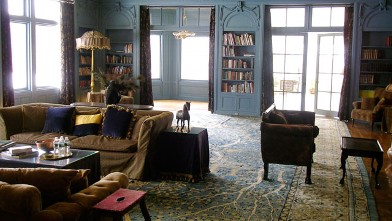
PHOTO: TripAdvisor.com

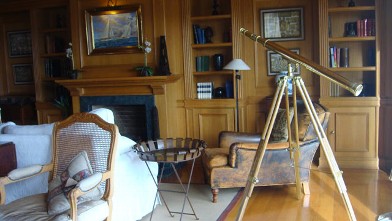
If you've ever wanted to experience a weekend as a house guest at a Vanderbilt summer house, visit Elm Court in Lenox, Mass. "The common rooms include a spectacularly adorned library with an eclectic collection of books on every topic imaginable, an all-glass conservatory that overlooks the mountains and a truly awesome, enormous, walk-in fireplace in the foyer where we sat at night drinking wine and toasting marshmallows," wrote one TripAdvisor traveler.
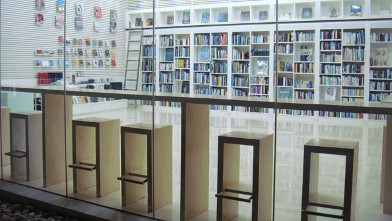
PHOTO: This ultra-modern resort has Macintosh computers in every room and an extensive library of books and DVDs.

This ultra-modern resort (the Trendiest Hotel in Thailand, according to TrIpAdvisor's 2012 Travelers' Choice Awards) is "a secret treasure amidst the madness" of Koh Samui. Each of its 26 rooms has a Macintosh computer, and travelers love the sumptuous breakfasts, unique red-tiled pool, and the property's extensive library of books and DVDs. One TripAdvisor traveler described it as "a treasury of literature from obscure design books to current paperback novels"; another simply called it, "a gold mine."
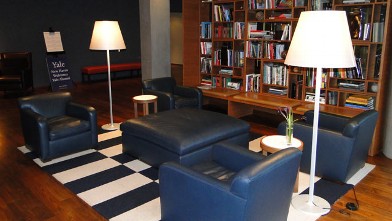
PHOTO: TripAdvisor.com

"The Study understands its audience ? Yale," wrote one TripAdvisor reviewer. Indeed, if you're in town visiting the university, you can't do much better for comfort or convenience than this boutique-style hotel in the middle of New Haven. The "sedate lobby with deep leather chairs" has a great selection of periodicals and art books, and the rooms have "sharpened #2 pencils instead of the typical pens."
"From the fabulous madhouse that is Soho you ring the brass bell of the discreet doorway to Hazlitt's Hotel and enter a calm and serene Georgian house," wrote one TripAdvisor reviewer. The London hotel's library room boasts an honesty bar: "Take your drinks and note in the book what you have taken and your room name-- wonderful idea."
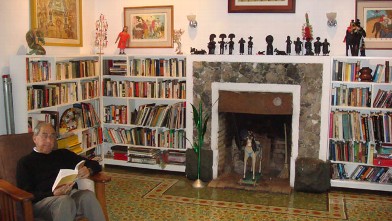
PHOTO: Void of the distractions of every day life, whether you're a reader or a writer, you'll be happy here.

"The lush gardens, fabulous food, amazing library, friendly people-- everything about it was perfect," wrote one TripAdvisor traveler of this Oaxaca, Mexico, hotel. Another traveler called it "a delightful and renewing place to hold our writing workshop"?so whether you're a reader or a writer, you'll be happy here.
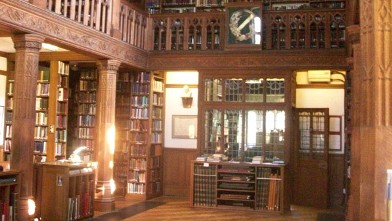
PHOTO: 
<p>
London's Gladstone's hotel library offers a haven without distraction.

"In a world of time-trials and interruptions, where juggling obligation, commitment and constraint has become the norm, Gladstone's Library offers a haven without distraction; a sandy cove of solitude with no more complicated an agenda than for readers to read and writers to write," wrote one TripAdvisor traveler of this hotel in North Wales. Indeed, another reviewer said he felt guilty reviewing Gladstone's on TripAdvisor, "because as the information sheet I was handed at check-in explains, it is a residential library-- it is not a hotel.'"
PHOTO: This boutique hotel in Lisbon has a lovely library and a helpful staff.

"An outstanding boutique hotel, beautifully furnished and with very helpful staff," wrote one TripAdvisor traveler of As Janelas Verdes in Lisbon, Portugal. It also happens to have a lovely library, complete with "a well stocked honesty bar (good value depending on how large you like your measures)."
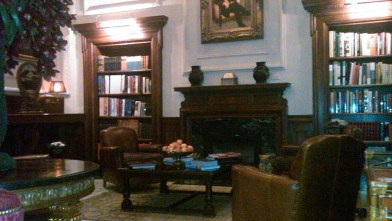
PHOTO: This Montreal hotel's library is located right off the lobby and has a great assortment of books, plus a fabulous fireplace.

"Everything is so clean, classy and luxurious that you immediately fall in love with the hotel," wrote one TripAdvisor reviewer who stayed at Hotel Le St-James in Montreal. The hotel's library, located right off the lobby, "is the size of a private, large dining room; very high ceilings; gorgeous fireplace; spectacular selection of books and magazines," wrote another.
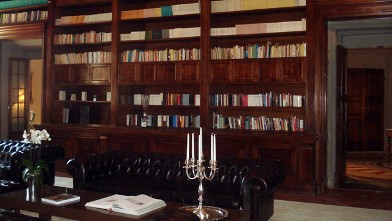
PHOTO: This Florence hotel has an exquisite library.

If you're a book lover and haven't already seen the major sights in Florence, do yourself a favor and don't stay at Il Salviatino? you'll probably never want to leave the hotel's exquisite library. The food also draws raves ("I will not be surprised when the chef earns a Michelin star," wrote one traveler). And, amazingly, the hotel welcomes kids?even providing organic baby toiletries.


Product Trainer-west (with Library Sciences Background).


Experience: 2 to 7 yrs.  | Salary: INR 3,00,000 - 6,50,000 P.A  |  Opening(s): 2

Job Description
Role involves visiting customer sites & imparting training / hands on with respect to Information database products. Role involves extensive travel 60% within West India.
Salary: INR 3,00,000 - 6,50,000 P.A. Higher compensation is not a constraint for the candidate, matching our requirements.
Industry: Education, Teaching, Training
Functional Area:
HR, Recruitment, Administration, IR
Role: Training Manager
Keyskills: LibraryLibrary Sciences, training, product training, Trainer, mumbai, 
Desired Candidate Profile
Education:
(UG - Any Graduate) OR (PG - MBA/PGDM)
candidate need to possess hands on "training" delivery experience, drive to excel & growth, excellent communication & presentation skills, ready for 60% travel within region - travel reimbursement will be provided by the Company.
Company Profile
Archangel HR Solutions
http://www.archangelhr.in
MNC into Information Digital Content & Database domain.
Contact Details
Recruiter Name:
Santosh, HR, Talent Acquisition
Contact Company:
Archangel HR Solutions
Address:
MG Road BANGALORE,Karnataka,India 560001
Reference Id:
Product Trainer-West (with Library Sciences background)

Fostering reading habits in youth


WEB LINKS

In an attempt to bring students closer to the world of books, INDIAreads Online Library launched ‘Literathon’, a nationwide initiative to foster greater interaction between students and the literary world.

Its inauguration recently took place at the Conference Hall, Delhi University in association with Delhi School of Economics. The event kick-started with launch of ‘Poor Little Rich Slum’, a book by Rashmi Bansal and international management consultant Dr Deepak Gandhi. 

There was also a book reading session by Member of Planning Commission Dr Syeda Hameed and Gunjan Veda who read from their new non fiction-  ‘Beautiful Country: Stories from Another India’.  

The event was a sincere endeavour to provide students and faculty with an opportunity to get acquainted with books and interact with renowned authors. Literathon comprises a host of activities including book launches, talks, interactive sessions, book readings, book bazaars, creative writing workshops and online and on-the-spot competitions.

Gunjan Veda, CEO of INDIAreads says, “The initiative has been conceptualised to make not just books but even their writers more accessible. Literathon is a celebration of books and we are hopeful that we spread this celebration in every state of India.”

Traditional archives rule over online ones


WRITTEN CHARM

As technology becomes increasingly available and digital information expands on a daily basis, academic library use is on the decline or so you would assume. 

Research libraries in colleges and university campuses are finding that gate counts and circulation of traditional materials are falling at many libraries across the country, as students find new study spaces in dorm rooms or apartments, coffee shops, or nearby bookstores. When all the information is available on mobile phones nowadays and news can be accessed with the click of a button, it looks like the humongous libraries are on way to becoming museums. 

But librarians who work in these places have a different take in this regard. According to them, libraries will never die out as they have their own charm. “The very concept of a library cannot end. It has a certain environment attached to it. Logo ko ek prakar ka anand milta hai yaha aake padhne me,” says Sudha Mukherjee, librarian at Delhi Public Library, H-Block, Sarojini Nagar. 

“Real readers look for satisfaction when they read a book and only a library can satisfy a reader. Online libr­a­ries can never be an alternative for physical libraries,” she further adds. 

The shift to electronic resources has many scholars and librarians worrying about the loss of a central community resource in physical libraries, whether they are at the university or public level. University boards are becoming increasingly skeptical about new additions and library buildings, since they cost so much. 

Many academics mourn the loss of a common culture of library use across campuses and communities while others hail the era of a new type of library with a new structure of knowledge and practical use. There has been a move to make the library seem more than a tool and storage house for books and information as different programmes are offered and coffee bars are added. This is a huge transition.

Another librarian Vandana Kamal Vanshi of National Archives, seconds Sudha and says, “Physical libraries are not losing their charm at all. Reading inside a library gives one a different feel all together. It cannot be compared with online libraries that are becoming increasingly available. They cannot give you the variety of reading as compared to the traditional ones. 

“One can have the access to each and every book available in a library but online, it is not possible for one to search all books at one time.”

With the rapid expansion of the internet to the general public, people are seeking answers in the quickest and most convenient way. While physical use may have been reasonably expected to decli­ne in recent years due to the large scale shift to digital libraries and the increase in sources such as e-journals, the trend has appeared to be on a much larger scale. 

An avid lover of books, Reshmi Sharma, a media professional cannot read anything online and only find satisfaction in reading an actual book. “I need to have the feel of a book. I cannot read online. I just do not get the feeling while reading something online.”

Going by the trend, the traditional library is here to stay though there is no denying that more and more libraries are increasingly digitising records and putting books for their readers. After all, the smell of a ‘real’ book can only be enjoyed by the bookworm.

Librarian and Asst. Librarian (Women Candidates) Vacancy at Avinashilingam University, Coimbatore, Tamil Nadu

Post: Librarian and Asst. Librarian
Job Location: Coimbatore, Tamil Nadu
University: Avinashilingam University,
[Institute for Home Science and Higher Education for Women]
Coimbatore, Tamil Nadu- 641043
Last Date: 23 August 2012
For Full Details visit: www.avinuty.ac.in


                    Source: The Hindu, 08 August 2012

Library that houses Archaeology Survey of India (ASI)'s Delhi Office


Located in the grounds of Ambedkar University, near the GPO, Kashmere Gate is the erstwhile Dara Shikoh Library, the building of which now houses the Department of Archaeology, Delhi Administration. 

The library was built by Shah Jahan’s intellectual son and chosen successor, Dara Shikoh. Dara Shikoh, known for his liberal ideas and who translated the Upanishads into Persian, was murdered by his brother Aurangzeb in 1659 – in the fight for supremacy of the throne. His property along with this library passed through several hands before the British finally took it from the Marathas in 1803.

Dara Shikoh Library was later used as a residency by Sir David Ochterlony, the first British Resident of Delhi. Sir Ochterlony renovated the original building of the library, added pillars to the front facade to form a verandah to the older structure. The present building, experts say, is but one of the rooms used by Dara Shikoh. At a careful glance, one can differentiate between the architectural Mughal designs which still exist in the interior of the building and the British styles on the exterior of the building. 

The variations in architecture also occur because the building was damaged to a great extent during India’s first war of Independence in 1857. The priceless collection of books and documents of the Mughal era were burned down by the British. However, one can still imagine the grandeur and opulence in which the first British Resident lived in Delhi, by just looking at the majestic imposing building. The building also characterised the nature of its first occupant, Sir Ochterlony. He was one of the only British officers who fully adopted the Mughal culture, customs, traditions and lifestyle.

Vacancy of Librarian at M..A. F. Academy, Noida

Post: Librarian
Job Location: Sec-62, Noida
School- M. A. F. Academy, 
A-43,  Sec-62, Noida
Contact No. 0120- 2400522, 6545202
Last Date- 18th August 2012


Library Helpler Teacher at Tagore International School, New Delhi

Post: Library Helper Teacher
Job Location: East of Kailash, New Delhi
School- Tagore International School, 
East of Kailash, New Delhi
Contact No. 26420088, 26433001
Last Date- 15th August 2012


Librarians Day will be Organise on Aug 12 at KK Handiqui State Open University, Assam

Vacancy of Librarian at D Y Patil Group, Pune


Librarian and Assistant Librarian at P K Polytechnic, Mathura


Vacancy of Senior Librarian at Delhi Public School, Gurgaon


University Librarian and Assistant Librarian at Ayush and Health Sciences University of Chhattisgarh


Vacancy of Librarian at Vivekanand Institute of Technology, Padambhushan Dr Vasantdada Patil College of Architecture, Pune

POST- Librarian
email resume to vitcoapune@gmail.com
Contact No. 020-20291299, 20291308

Assistant Librarian Vacancy at KC Group, Himachal Pradesh

Post: Asst. Librarian
Job Location: Una, Himachal Pradesh
Institute: KC Group of Institution, Pandoga, 
Una, Himachal Pradesh
Selection Mode: Walk in Interview
Walk in on 9 August, 2012
Source: The Tribune, 08 August 2012

SIS Fellowship Awards for the year 2012


SIS Fellowship Awards for the year 2012
  
Nominations Invited for SIS Fellowship and for Young Information Scientist Awards for the year 2012. The Society for Information Science (SIS) awards SIS Fellowship every year to honor and recognize outstanding contributions in the area of information science and technology, and Young Information Scientist Award (instituted in 1989 in the memory of Late Shri A.S. Raizada, eminent information scientist and founder Secretary of SIS).
 
Nominations are hereby invited for the SIS Fellowship and the Young Information Scientist AWARDS for the year 2012. Nominations can be made by the Professors, Heads of the Departments, Institutional Heads, Heads of Libraries, SIS Fellows, and Members of SIS.
 
 Nominations must be sent to the Secretary SIS by 15 September 2012, along with complete biodata of the nominee, including his/her contributions to the field. Kindly note that self-nominations or nominations without biodata will not be considered. In the case of Young Information Scientist Award, the age of the nominee should not be more than 35 years as on 15 September, 2012.
 
All nominations should reach the Secretary SIS, (at the following address) by 15 September 2012, after which no nomination will be considered.
 
N.K. Wadhwa,
Secretary, Society for Information Science, (SIS)
C/O The Knowledge Resource Centre,
CSIR- National Physical Laboratory,
Dr. K.S. Krishanan Marg,
New Delhi-110012
(Ph: 09350090040)

Tuesday, August 7, 2012

Research and Documentation Specialist at Child Fund, Delhi


Librarian at Vivekananda Mission School, Joka, Kolkata

Post: Librarian
Ed. Qual: MLIS / BLIS
Send Resume to : Principal, Vivekananda Mission School, Vivek-Ville, Opp, IIMC, P.O. Joka, Kolkata-700 104
Last Date: 14 August 2012

Source: The Telegraph, 07 August 2012

walk-in-interview on 10 August 2012 Kerala University, Thiruvananthapuram

No.Ad.B.III.1/11431/2012.
                                                          Thiruvananthapuram
Dated:31.07.2012

A walk-in-interview is scheduled to be held at 10.30 AM on 10.08.2012 at the University Office, Senate House Campus, Thiruvananthapuram for the selection of Librarian on contract basis in the Extension Centre of Institute of Management in Kerala, Adoor.
Qualification Required:
B. L. I. Sc. Degree from a recognised University.
Age: Not above 35 years as on 01.06.2012.
Remuneration (consolidated): R 9,000/- per month
The desirous candidates having required qualification should report at 09.30 AM on 10.08.2012 at the University Office, Senate House Campus, Thiruvananthapuram along with the original certificates to prove their age, qualifications, experience, community etc.

Librarian at Delhi Public School, Bhagalpur


My Tree House, World's 1st Green Library for Kids

A National Library Board and City Developments Limited Collaboration

The National Library Board (NLB) and City Developments Limited (CDL) unveiled plans to develop the World's 1st Green Library for Kids named as “My Tree House”. This library development is a synergistic partnership between NLB and CDL. “My Tree House” is steered by green principles in all facets from design, infrastructure and use of sustainable materials, to collection and programming.

Attributes of “My Tree House”
“My Tree House” is a unique green library purposefully conceptualised, constructed and operated with environmental sustainability in mind. CDL will provide green expertise from its vast experience of developing eco-friendly properties and integrate comprehensive sustainable practices to create a green prototype library for kids. The eco-directive set for this innovative first-of-its-kind project will ensure that every detail from the holistic conceptual design and infrastructure, materials used in the construction, incorporation of innovative key features, are not only sustainable but proactively reinforce the overall green concept.

CDL has brought together other like-minded corporations, who are leading green players in their own fields, to lend their expertise and support in this groundbreaking initiative. These partners include ADDP Architects LLP – the design consultant led by Mr Tang Kok Thye, recently awarded Green Architect of the Year 2012 by Building and Construction Authority (BCA); Interface – the world's largest manufacturer of sustainable carpet tiles which will provide the carpeting for this library; and Royal Philips Electronics – a world leader in healthcare, lifestyle and lighting, which will be the lighting consultant and supplier of energy-efficient lighting solutions and fittings for “My Tree House”.

The library has been designed to create an enchanted forest ambience with fun spaces for hands-on learning and reflections. “My Tree House” takes its name aptly after the centrepiece which is a tree house structure constructed with recyclable materials. It will evoke the feeling of a special place for children as featured in story books.  

Targeted for completion in mid-2013, the library will be home to 70,000 books. About 30% of these books will focus on green topics such as animals, plants, nature, water resources, environment and climate change. NLB plans to work with other public agencies such as the Ministry of the Environment and Water Resources, National Climate Change Secretariat, National Environment Agency, National Parks Board and PUB, Singapore's National Water Agency in developing the library's collection and on using the library for environmental education and outreach. A wide range of tailored activities like games, storytelling and craft-making to spur interest in children ages 4 to 12 are being planned. NLB is also gathering feedback and suggestions to customise the experience for child visitors. Members of the public can provide suggestions through email or forms at the library.

Mrs Elaine Ng, Chief Executive Officer of NLB said, “We are breaking new ground in public, private and people sector collaboration in library development. Together with City Developments Limited and its partners, we are creating a special library that will encourage children to explore, discover and challenge their curiosity in learning and caring for the environment. 'My Tree House' will help to nurture children to grow up to be environmentally-conscious adults.”

Ms Esther An, CDL's Head of Corporate Social Responsibility and General Manager (Corporate Affairs) added, “CDL has been championing the development of green buildings in Singapore for over a decade. Pioneering this children's library with NLB is the perfect amalgamation of CDL's green building expertise, commitment to greening private and public spaces, and most importantly, raising eco-awareness amongst the young for the benefit of our community and the environment. This is in line with our long-standing commitment to youth development and promoting sustainable development.”

This green library will be appropriately housed at the Central Public Library located within the National Library Building. This building first received the Green Mark Platinum Award in April 2005 and subsequently in March 2009. This is the highest honour for green buildings in Singapore bestowed by the BCA. In July 2007, it also won the first prize in the ASEAN Energy Efficiency Awards under the “New and Existing Building” category. In May 2007, the Building was given the Silver Award in the Universal Design Award from BCA, for its wide spaces, good lighting, accessibility and clarity in wayfinding.

New ISO standard for library buildings

Information and documentation - Qualitative conditions and basic statistics for library buildings -- Space, function and design


ISO/TR 11219:2012 specifies data for the planning of library buildings. It also provides guidance on the selection of technical building equipment for the different functional areas of libraries. 
ISO/TR 11219:2012 is applicable to all types of libraries in all countries, but especially to academic and public libraries.

The Bookless Library


Don’t deny the change. Direct it wisely.

THEY ARE, in their very different ways, monuments of American civilization. The first is a building: a grand, beautiful Beaux-Arts structure of marble and stone occupying two blocks’ worth of Fifth Avenue in midtown Manhattan. The second is a delicate concoction of metal, plastic, and glass, just four and a half inches long, barely a third of an inch thick, and weighing five ounces. The first is the Stephen A. Schwarzman Building, the main branch of the New York Public Library (NYPL). The second is an iPhone. Yet despite their obvious differences, for many people today they serve the same purpose: to read books. And in a development that even just thirty years ago would have seemed like the most absurd science fiction, there are now far more books available, far more quickly, on the iPhone than in the New York Public Library.
It has been clear for some time now that this development would pose one of the greatest challenges that modern libraries—from institutions like the NYPL on down—have ever encountered. Put bluntly, one of their core functions now faces the prospect of obsolescence. What role will libraries have when patrons no longer need to go to them to consult or to borrow books? This question has already spurred massive commentary and discussion. But in the past year, as large-scale controversies have developed around several libraries, it has become pressing and unavoidable.
The most heated of these controversies involves the NYPL itself, which has long served as a model for other major American libraries. Under an ambitious Central Library Plan drawn up under its previous president, Paul LeClerc, the institution is preparing to banish millions of books from the venerable stacks of the main branch to off-site storage in central New Jersey, from where it will take them at least twenty-four hours to arrive in the grand Rose Main Reading Room. The plan also involves the sale of decrepit nearby facilities (notably the mid-Manhattan branch lending library, one of over eighty branch libraries in the NYPL system) and the consolidation of their functions in a renovated Schwarzman Building. The plan did not come in any direct sense as a response to digitization, but clearly digitization has made the removal of physical books easier for the library to contemplate. The protests against the plan, which include a letter signed by several hundred prominent writers and academics, have gone so far as to allege that the NYPL’s new president, Anthony Marx, formerly the head of Amherst College, sees the libraries of the future less as repositories for books and learning than as glorified Internet cafés.
This last charge is clearly incorrect. Marx arrived at the NYPL only a year ago, at a moment when the Central Library Plan had already advanced too far to be canceled. He is also, like virtually every other library director in the United States, operating under severe financial constraints. Even the Harvard University library system has seen its budget shrink drastically over the past few years, and the reduction of its staff by over a third (making it the focal point of another library controversy). At the NYPL, the acquisitions budget has shrunk 26 percent over just the last four years. Simply by consolidating several different facilities in a single building, Marx claims the new plan will save as much as $16 million a year in operating costs, or the equivalent of adding 50 percent to the library system’s endowment. The high-profile redesign of the Schwarzman Building—by Norman Foster—will attract additional funding. And Marx is anything but a barbarian geek at the gates. To the contrary, he clearly wants to put as many paper books in as many hands as possible. Among his other initiatives, he is developing a program under which all New York City public school students will be able to order books from the NYPL system, and have them delivered directly to their schools within twenty-four hours.
The critics of the Central Library Plan do have a point when they suggest that it will make the NYPL a more difficult place in which to do serious research. Even if the development of new storage spaces underneath adjacent Bryant Park minimizes the number of books ultimately shipped to New Jersey, there will still be many moments when a reader, paging through a book, excitedly learns of another one crucial to her topic, only to find that it is off-site. (The same thing occurs in many university libraries, which are making increasing use of off-site storage.) Placing a lending library in a large, attractive open space within the main branch will probably at least double the already considerable foot traffic in the building, adding to its levels of noise, dirt, and disruption, although the library is also creating new spaces for serious scholars and writers.
Soon most if not all libraries will be facing quandaries similar to that of the NYPL, owing to the devices on which more and more people are doing more and more of their reading. Already at least a fifth of all book sales come from e-books, and the numbers are rising fast. Total e-book sales in January 2012 came in close to twice those of a year previously, and were more than ten times the figure for January 2009. The Pew Internet and American Life Project reports that 21 percent of all Americans have read an e-book in the past year, with the proportion predictably higher among the young. Nearly all of the most popular English-language titles are downloadable, including millions of free books in the public domain, mostly digitized by Google Books. Amazon and Barnes & Noble sell hundreds of thousands of copyrighted titles for a price similar to or lower than that of the equivalent paperback. When the Harry Potter novels finally appeared in electronic versions this spring, they racked up $1.5 million in sales in just three days.
This technology cannot simply substitute for the great libraries of the present. After all, libraries are not just repositories of books. They are communities, sources of expertise, and homes to lovingly compiled collections that amount to far more than the sum of their individual printed parts. Their physical spaces, especially in grand temples of learning like the NYPL, subtly influence the way that reading and writing takes place in them. And yet it is foolish to think that libraries can remain the same with the new technology on the scene.

A new chapter for Beijing's libraries


By Zheng Xin (China Daily)


A new chapter for Beijing's libraries
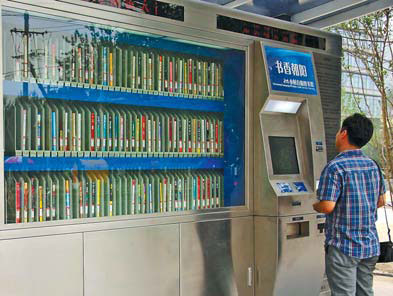
A self-service library attracts a passer-by's attention in BeijingrecentlyContaining more than 400 booksit allows users toborrow and return books 24-hours a dayLu Ming / ChinaNews Service
Self-service libraries are becoming increasingly popular with Beijing residentswith 50 havingsprung up across the city over the past year and 100 more are expected to open in the comingmonths.
The 24-hour service allows readers to choose from 20,000 books housed in giant automaticmachines scattered across the capital.
And the convenience of the service has proved popularwith self-service libraries being thesource of 31.63 percent of all books borrowed from public libraries in Beijing's Chaoyangdistrict since they were introduced last year.
Tao Juna publicity officer at the Chaoyang District Librarysaid the service was beneficial toreaders.
"The book vending machine has extended library service hours and has fewer locationlimitations than its traditional counterpart," Tao said.
An additional 100 self-service libraries will be set up in highly populated areas in the capital bythe end of the year as demand increasesshe said.
A single self-service librarycontaining more than 400 booksresembles an ATM but is aboutthe size of three carsBorrowers can keep five books for up to four weeks at a time.
Readers can register with their ID card for a membership at a public library for 100 yuan ($16),allowing them to borrow books from both the city's traditional libraries and the new self-servicemachines.
When the self-service machine is running short of books or is damagedthe library will beinformed through its data center and cameras installed in the remote device.
Li Anyina retired resident in Chaoyang districtsaid the self-service machines were veryconvenient and easy to use.
"I can return or borrow a book anytime of the dayeven early in the morning before I go for astroll in the garden," he said.
"Returning the books can be done in a flexible way and you no longer have to rush to have thebooks returned before the library closes."
Li said he has introduced two of his "morning strolling partnersto the new machines.
Despite the conveniencesome residents complain that the machinesselection of books lacksvariety.
"Leafing through the booksyou can hardly find a English novel or any fiction," said Wang Yue, 24, a graduate from Beijing Foreign Studies University.
Tao said there is little demand for foreign language books.
"Most of the books available are Chinese fictionbiographycookery and horticulture," saidTao. "Howeverthe library will consider catering for different tastes and including more books."
Tao said the library will also consider allowing the public to use passports to register for librarymembershipsopening the service to foreign bookworms.
Shenzhen in Guangdong provincethe first city in China to introduce the self-service library,now houses 160 machinesand 40 more are to be opened by the end of the yearaccording toNie Changyouan officer at the Shenzhen city bureau of culturesport and tourism.
Li Xinliangmarketing director of Shenzhen Seaever Intelligent Technology Cothe companythat makes the machinessaid interest in the service is growing across the country.
"In 2008, we only received an order for 10 machinesbut the demand soared to 180 in the year2011," Li said.